What We Inherit: Intergenerational Trauma, Birds That Trust, and the Patterns We Never Chose
There are a lot of names for the same thing.
Intergenerational trauma. Ancestral trauma. In Internal Family Systems, we call it legacy burden — the weight a part of you carries that was never yours to begin with. Different vocabularies, different lineages of thought, all circling the same truth: something gets passed down. Not just genes and heirlooms, but something harder to name. The energetic residue of how the people before us survived. Their values. Their fears. The way they understood the world and their place in it. Gender roles. Religion. Who gets to speak and who learns to stay quiet. What love is supposed to look like. What control us from our authentic self, whatever that discovery might be.
We absorb these things before we have language for them. They arrive not as lessons but as atmosphere — the unspoken rules of the house, the things that were never said but everyone knew. By the time we’re old enough to question them, they don’t feel like beliefs we hold. They feel like reality itself.
The work of healing — whether you’re doing it with a therapist, a spiritual guide, a plant medicine facilitator, or some combination — almost always begins with the same recognition: this pattern isn’t mine. It came from somewhere. The unhealed wound my grandmother carried, that my mother carried, that I’m now carrying without ever having been the one who was hurt. Naming that lineage is often the first loosening of the grip.
A park where the birds trust people
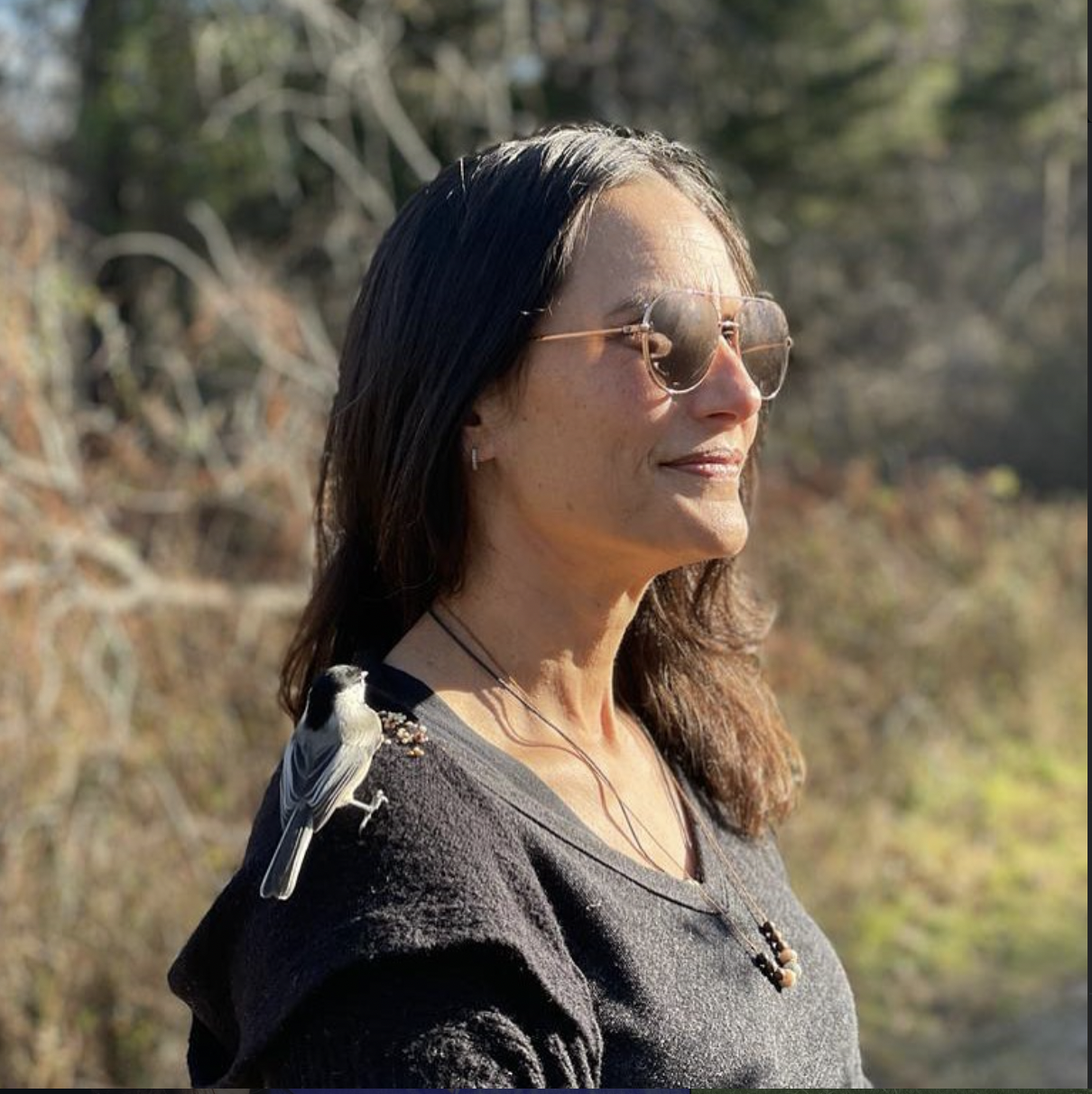
There’s a place on the eastern end of Long Island called the Elizabeth A. Morton National Wildlife Refuge. If you’ve never been, here’s what makes it strange and magical.
Word has it, that since at least the 1970s, the birds there have done something birds almost never do anywhere else in the world: they trust humans. You walk the trail with a handful of seed in your open palm, you stand still, and within a few minutes a black-capped chickadee or a tufted titmouse will drop out of the trees, land on your fingers, and eat right from your hand. It is one of the most quietly astonishing things you can experience, and it has been happening for decades.
Here’s the part that matters for our purposes. No single bird at Morton was taught to trust humans by a scientist. The trust is inherited. Each new generation of chickadees learns it by watching the older birds — by observing that the large slow creatures on the trail are safe, that the open hand means food and not danger. The behavior is transmitted down the generations without anyone deciding to transmit it. It’s just how things are done here now.
And the humans learn it the same way. As the photo on this page shows, a little chickadee landed on my shoulder. It was incredible. Nobody is born knowing you can feed a wild bird from your hand. You learn it because you saw someone else do it, or someone told you, as it happened to me when a stranger handed me a handful of seeds and said “put your hand out, and see what happens”. And as the photo shows, I started putting seeds on my shoulder. The knowledge — and the trust, and the patience the trust requires — gets passed from person to person, year after year, generation after generation of visitors.
Morton is a living demonstration of how things get passed down. In this case, it’s beautiful. Trust, transmitted across generations, on both sides of the open hand.
But every pattern has a shadow side.
The same mechanism, turned dark
If trust can be inherited without anyone deciding to teach it, so can fear. So can shame. So can the belief that you are less than, or that your body belongs to someone else, or that survival depends on staying small.
Consider the people who were brought to the United States without their consent, in chains, during the centuries of slavery. The trauma of that — the terror, the grief, the rupture of family and language and home, the daily reality of being treated as property — did not end when slavery legally ended. It was passed down. From one generation to the next, in the body and the nervous system and the unspoken rules of survival, the same way the chickadees at Morton passed down their trust. Except what was transmitted was the opposite of trust. Researchers and clinicians now have a substantial and growing literature on the intergenerational transmission of trauma in descendants of enslaved people, of Holocaust survivors, of communities subjected to genocide and displacement. The wound outlives the wounding.
This is the shadow of Morton. The mechanism is identical. Only the content differs.
Plant medicine work often brings this into sharp, sometimes unbearable focus. People sit with ayahuasca or psilocybin or kanna and find themselves face to face with patterns they had assumed were simply who they are — and realize, often for the first time, that these patterns have a history. That the rigidity, the self-denial, the fear, the particular shape of their shame, was handed to them. It belonged to someone else first. There can be enormous grief in that recognition, and enormous freedom: ‘This was never mine. I’m allowed to set it down’.
I know this one from the inside. In my first plant medicine ceremony, I watched my own brownness get edited out of the picture — and slowly understood that it had been edited out long before I ever showed up. I’m biracial, but somewhere along the line an idealization of whiteness had become the water I swam in, so quietly that I’d never questioned it. My brown skin, my Indigenous roots, the parts of me that didn’t fit the preferred image — they hadn’t just been overlooked. They’d been quietly put down, and I had absorbed the verdict without noticing. What the medicine showed me, as I sat with my own family line, was that the people who came before me had been colonized, and that idealizing whiteness had been, for them, a way to survive it. The erasure wasn’t a personal failing or even a personal choice. It was a legacy burden, passed down hand to hand, until it landed in me and started running my sense of what was beautiful and what was acceptable before I was old enough to consent to any of it. Seeing it took a long time. Setting it down is taking longer. But it started with that first clear look: oh — this was never mine.
Gender is one of the places this shows up most rigidly. For many people, the rules about what a man is and what a woman is and how each is supposed to move through the world feel less like culture and more like physics — fixed, natural, beyond question. But they’re inherited, too. They were transmitted across generations, anchored by people who are long gone, perpetuated by people who never thought to ask why. This is often seen in the religious messages that are passed down from generations to generations, making it difficult to even challenge.
Being queer can be such a disruption to the whole apparatus. I used to want to call it ironic, but that isn’t quite the right word — there’s nothing accidental about it. Living openly outside the inherited script doesn’t just bend the rules; it reveals that they were rules in the first place, choices someone made, rather than the natural order of things. Queerness interrupts the transmission. It’s one of the ways a lineage stops simply repeating itself, for instance, passing down definition of gender roles, and starts asking what it actually wants to keep.
What the research says about inheriting things we never chose
Two studies are worth knowing here, partly because both have escaped into popular culture in distorted forms, and it’s worth getting them right.
The monkeys. You may have heard the famous story of five monkeys in a cage, a banana at the top of a ladder, and a cold-water hose — where new monkeys are added one by one until none of the originals remain, yet they all still attack any monkey who approaches the ladder, “because that’s how it’s always been done.” It’s a wonderful parable. It also never happened; it’s an invented business fable.[1]
But the real study underneath it is just as instructive. In 1967, primatologist G. R. Stephenson conditioned rhesus monkeys to avoid touching an object by punishing them with a blast of air. He then paired each trained monkey with a naïve one who had never been punished. The naïve monkeys, simply by observing their trained partners — in one case being physically pulled away from the object — learned to avoid it themselves, even though nothing bad ever happened to them.[2] A fear with a real origin got transmitted to an individual who had no idea why it was there. Sound familiar?
The bell in the waiting room. You may also have seen the clip — usually from the TV show Brain Games — where a waiting room full of actors stands up every time a beep sounds. A real subject, confused, eventually starts standing too. The actors leave one by one, new people arrive, and the standing-at-the-beep keeps perpetuating itself across “generations” of strangers, none of whom know why they’re doing it.[3] It’s a great demonstration, but it’s a TV staging, not a controlled experiment.
The actual science behind it is a 1961 study by Robert Jacobs and Donald Campbell. Using an optical illusion in a dark room (where a stationary point of light appears to move), they planted confederates who reported wildly exaggerated estimates, establishing a false group “norm.” Then they replaced group members one at a time with naïve participants. The arbitrary, made-up norm persisted for several “generations” of subjects beyond the point when the last confederate had left the room — a tradition with no basis in reality, sustained purely by transmission.[4]
That’s the whole thing in a laboratory. A belief that was never true, anchored by people who are now gone, faithfully passed down to people who have no idea where it came from and keep it alive anyway.
Where therapy comes in
If you’ve read this far, you probably recognize something in this. A pattern you didn’t choose, a fear that arrived before you could name it, a way of moving through the world that you’ve always wondered about but never quite traced to its source. That’s not weakness. That’s inheritance.
The good news hidden in all of this is that transmission works in both directions. What gets passed down can also be interrupted. The patterns that were conditioned can be reconditioned. The norms that were installed without your consent can be examined, and some of them can be revised. This is, in fact, much of what therapy is for.
But you can’t revise what you can’t see. The first step is almost always just naming it: this pattern didn’t start with me. This fear has a lineage. This way of relating to my body, to authority, to closeness, to danger — it came from somewhere, and I absorbed it before I had the words to question it. Naming that doesn’t make it disappear, but it does change your relationship to it.
In the work I do, that often means spending time with parts of yourself that carry the old patterns — not to eliminate them, but to understand where they came from and what they were trying to protect. Internal Family Systems work is particularly useful here, because it treats inherited patterns not as flaws to be fixed but as adaptations that made sense in context. The context has changed. That’s the opening.
You didn’t choose most of what you inherited. But once you can see it clearly, what you do with it is finally, genuinely, yours.
[1] The “five monkeys and the ladder” story appears to originate as a business anecdote popularized by Hamel and Prahalad. Despite widespread use as a psychology reference, no such experiment is documented in the scientific literature.
[2] Stephenson, G. R. (1967). Cultural acquisition of a specific learned response among rhesus monkeys. In D. Starek, R. Schneider, & H. J. Kuhn (Eds.), Progress in Primatology (pp. 279-288). Stuttgart: Fischer.
[3] The standing-at-the-beep demonstration appears in the National Geographic series Brain Games, “Conformity” episode. It is a staged demonstration rather than a controlled experiment, but effectively illustrates behavioral transmission through conformity.
[4] Jacobs, R. C., & Campbell, D. T. (1961). The perpetuation of an arbitrary tradition through several generations of a laboratory microculture. Journal of Abnormal and Social Psychology, 62(3), 649-658.